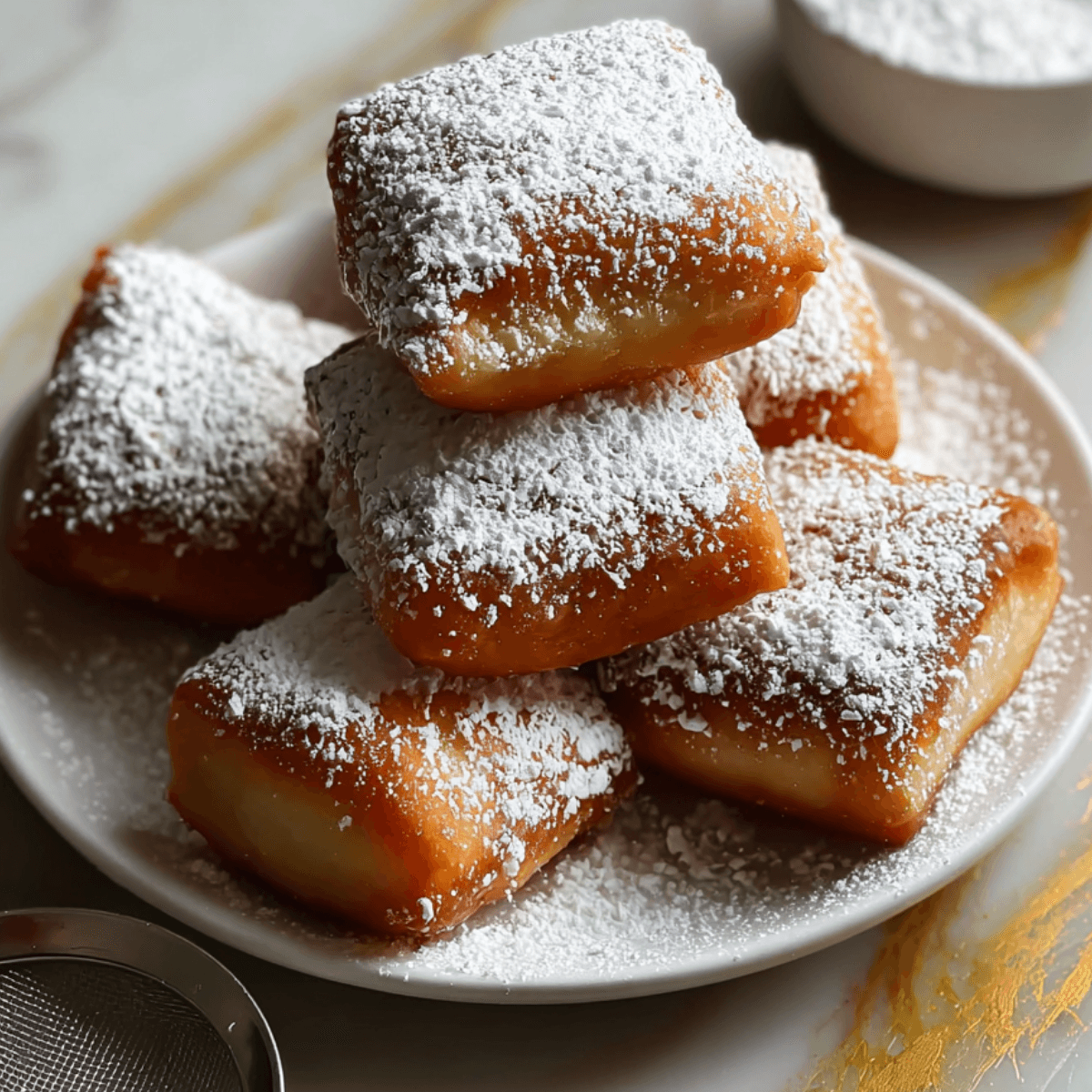
The oil was not hot enough, and every single one absorbed it like a sponge. Ben picked one up; it was visibly heavy, and said “this is not right.” Mia ate one out of loyalty and said “still good.” They were not. But once I got the temperature right, these vanilla French beignets became the most magical thing I have ever made in this kitchen.
Why This Recipe Is Special
Beignets are one of those things that feel genuinely celebratory every single time they appear on the table. The dough is pillowy and soft inside, the outside is golden and just barely crisp, and the powdered sugar goes everywhere in the best possible way. The vanilla in this recipe is not subtle; it perfumes the whole dough and gives every bite a warmth that plain beignets simply do not have. Mia takes one bite, closes her eyes for a second, and then immediately reaches for another. That is the only review that matters to me.
How To Make Vanilla French Beignets
The successful batch happened on a Sunday afternoon when both kids had declared the day officially boring and needed a project. Mia was measuring the flour with the focus of someone taking an exam. Ben was reading the yeast packet out loud and asking follow-up questions about what yeast actually does, which led to a genuinely good five-minute conversation about fermentation that I had not planned for. When the dough came together and felt soft and elastic and pillowy under my hands, I let both of them have a turn pressing it, which Mia described as “the best part.” Ben agreed and then pressed it one more time for good measure.
The oil temperature lesson was the one that changed everything. Beignets need oil at exactly 350 to 360 degrees F. Too cold, and they absorb oil and go heavy. Too hot and the outside burns before the inside cooks through. I now use a thermometer every single time, and Ben has appointed himself the official temperature reader, which means he announces “three fifty-two” in a very authoritative voice approximately every thirty seconds while I fry. The beignets have been perfect ever since.
Main Ingredients
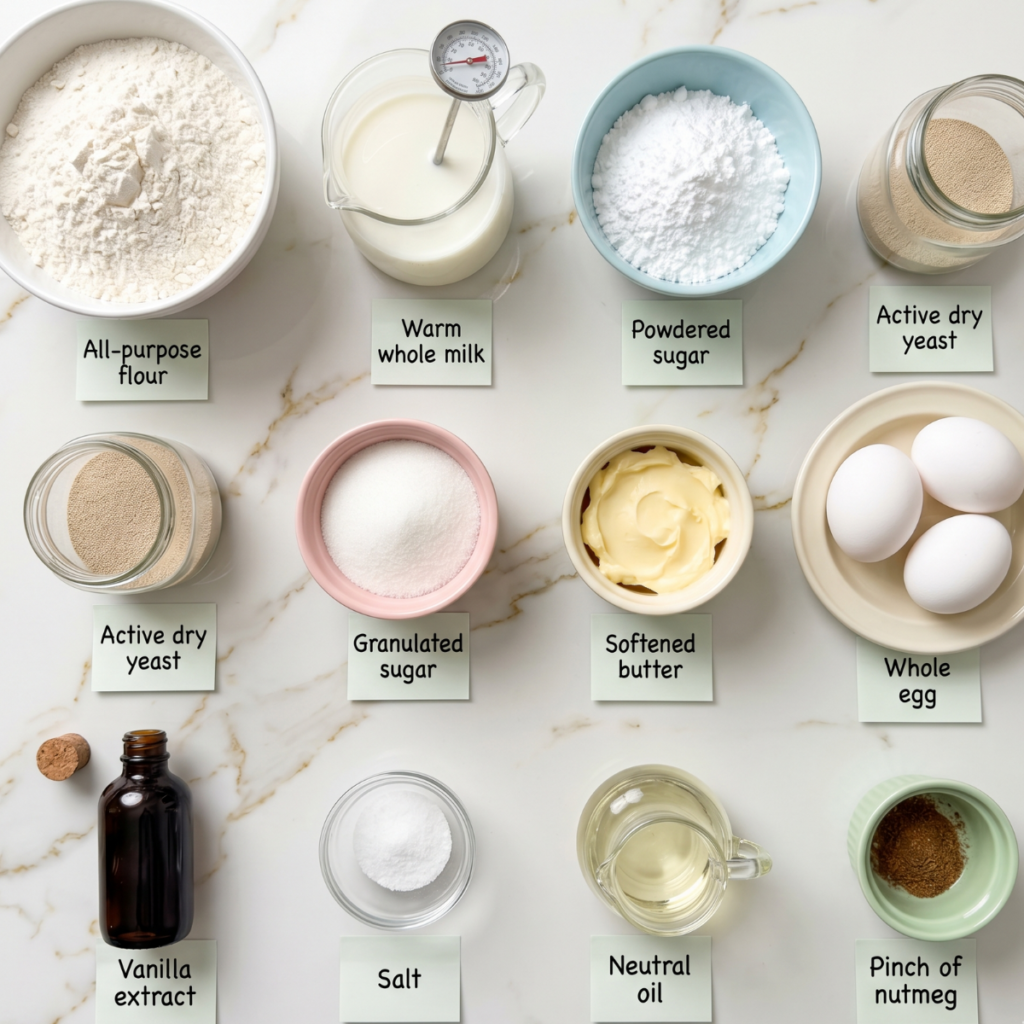
- 2.5 cups all-purpose flour, plus extra for dusting – Spoon and level; the right flour amount gives the perfect soft but structured dough
- 2.25 teaspoons active dry yeast (one standard packet) – Must be proofed in warm liquid first; this is not optional for a properly risen beignet
- 3/4 cup warm whole milk (110 degrees F) – Activates the yeast; too hot kills it, too cold and it will not activate at all
- 1/4 cup granulated sugar – Feeds the yeast and gives the dough its subtle sweetness
- 2 tablespoons unsalted butter, softened – Adds richness and gives the beignets their tender, slightly glossy interior crumb
- 1 large egg, room temperature – Gives structure and helps the dough hold together beautifully during frying
- 2 teaspoons pure vanilla extract – The heart of this recipe; use good quality vanilla and do not reduce the amount
- 1/4 teaspoon salt – Balances the sweetness and enhances the vanilla
- Neutral oil for frying – Vegetable or canola oil; at least 3 inches deep in the pot for the beignets to float and fry evenly
- 1 cup powdered sugar, for dusting – Applied generously and immediately while the beignets are still hot; this is non-negotiable
Step-by-Step Instructions
Step 1: Proof the Yeast and Make the Dough
- Combine the warm milk (110 degrees F), sugar, and yeast in a large bowl and let it sit undisturbed for 5 to 10 minutes until the mixture is foamy and fragrant; if it does not foam, the yeast is dead and you need to start again with fresh yeast
- Add the softened butter, egg, vanilla extract, and salt to the yeast mixture and stir until combined
- Add the flour one cup at a time, stirring after each addition until a soft, slightly sticky dough forms that pulls away from the sides of the bowl
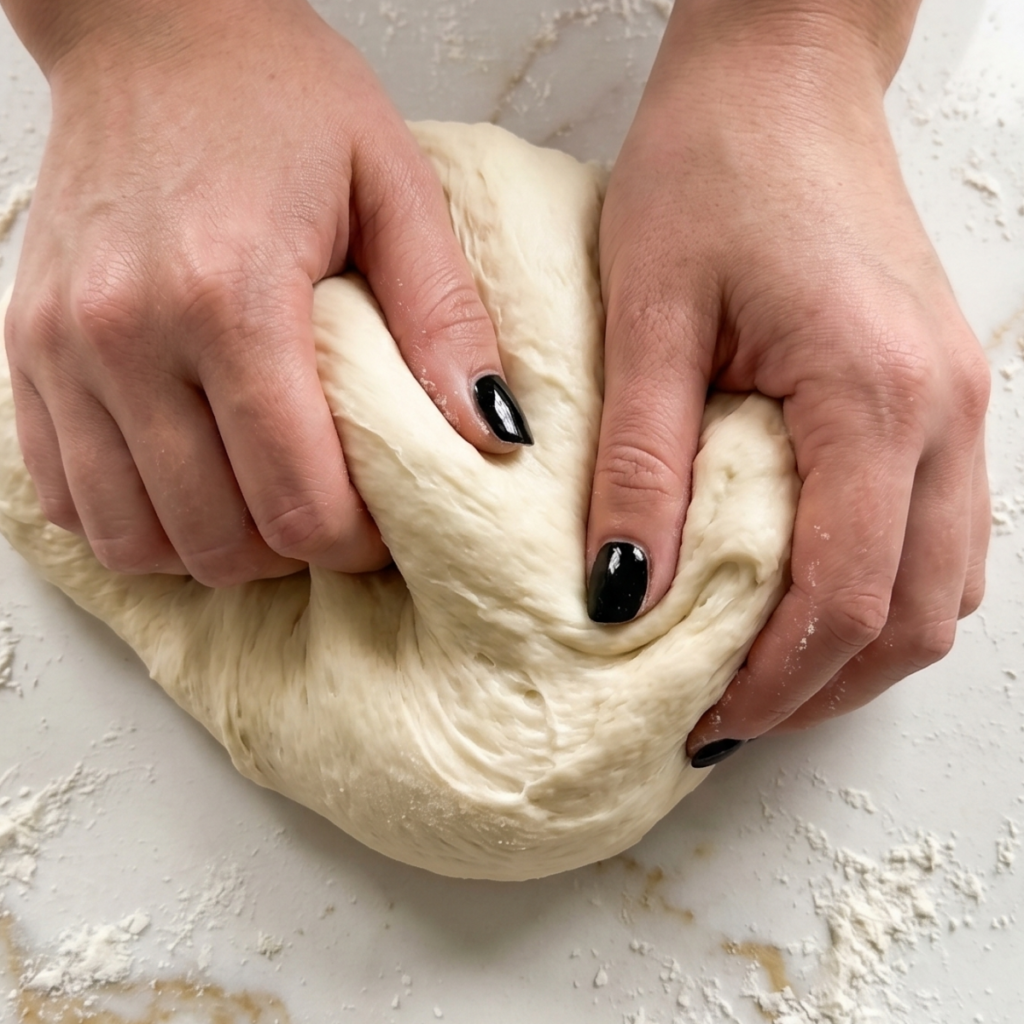
- Turn the dough out onto a lightly floured surface and knead for 3 to 4 minutes until smooth and elastic; the dough should spring back slowly when you press it with your finger
Step 2: Rest and Roll the Dough
- Place the dough in a lightly oiled bowl, cover with a clean kitchen towel or plastic wrap, and let it rise in a warm spot for 1 to 1.5 hours until doubled in size
- Punch the risen dough down gently to release the air, then turn it onto a lightly floured surface
- Roll the dough out to about half an inch thickness and cut into squares or rounds roughly 2 to 3 inches across using a knife or biscuit cutter
- Place the cut pieces on a lightly floured parchment-lined tray and cover loosely; let them rest for 15 minutes while the oil heats so they puff slightly before frying
Step 3: Fry the Beignets
- Heat at least 3 inches of neutral oil in a deep heavy-bottomed pot to exactly 350 to 360 degrees F using a kitchen thermometer; do not guess the temperature
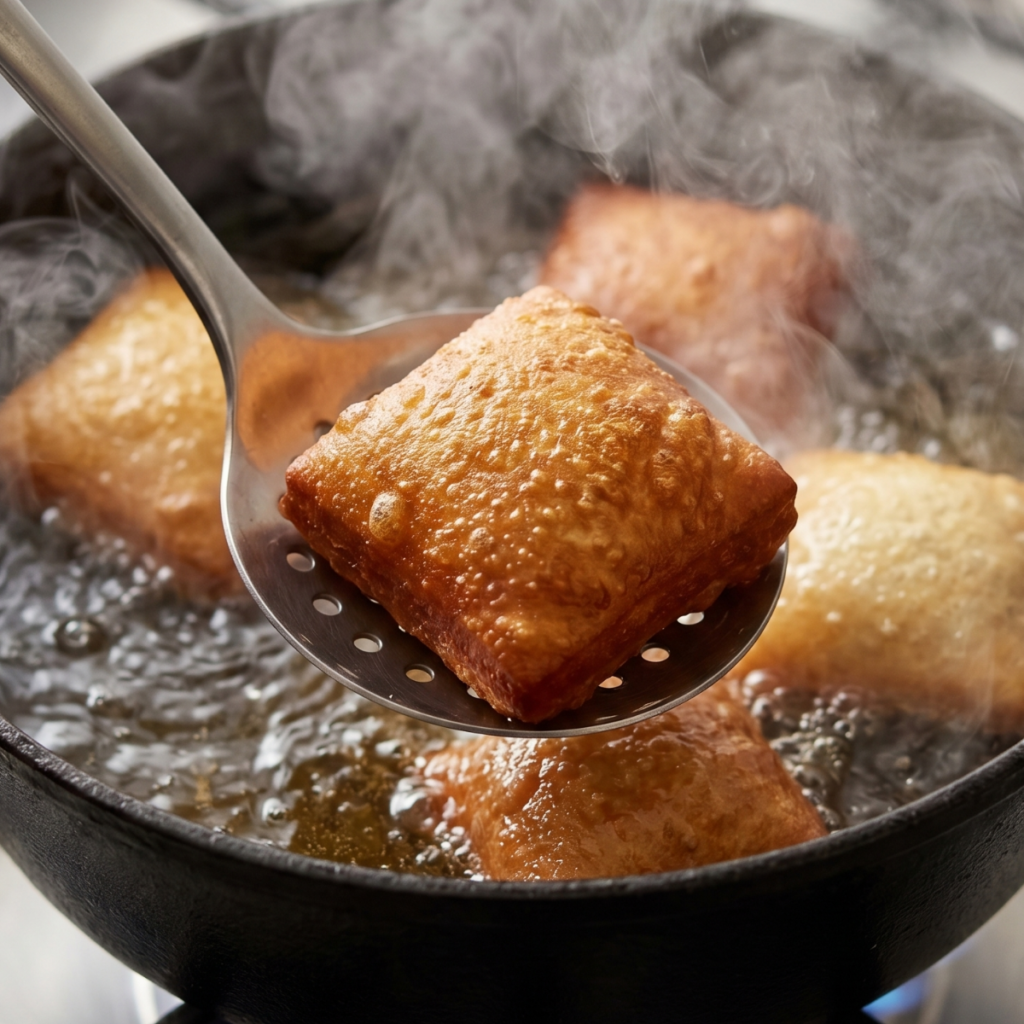
- Fry 3 to 4 beignets at a time without crowding, lowering them gently into the oil with a slotted spoon; they will puff and float to the surface within about 30 seconds
- Cook for 1 to 2 minutes per side until deep golden brown on both sides, turning once with a slotted spoon or tongs; the total fry time per beignet is about 3 minutes
- Transfer to a paper towel-lined tray to drain for about 30 seconds and monitor the oil temperature between batches, adjusting the heat as needed to keep it in the correct range
Step 4: Dust and Serve
- While the beignets are still hot, transfer them to a serving plate and dust immediately and very generously with powdered sugar through a fine mesh strainer
- Pile them on the plate and dust again from above so the powdered sugar settles into every crack and crevice; this is not a moment for restraint
- Serve immediately while the inside is still soft and pillowy and the outside is at peak golden; beignets are a now-food, not a later-food
- Set up a dipping station alongside if desired with vanilla custard, Nutella, jam, or honey so everyone can customize their experience
Vanilla French Beignets Variations
Mia’s “Nutella-Filled” Version
Mia discovered that Nutella-filled beignets existed when she saw them on a baking video and immediately treated this as urgent news. She presented the information to me at breakfast the following morning with the energy of someone reporting a major development. For filled beignets, roll the dough slightly thinner, place a small teaspoon of Nutella in the center of each piece, fold the edges up, and pinch firmly to seal and fry sealed-side down first. The Nutella melts inside during frying into a warm, gooey center that Mia describes as “the whole point of beignets.” She is probably right.
Ben’s “Cinnamon Sugar Instead” Version
Ben has a position on powdered sugar, which is that cinnamon sugar is objectively better, and he is willing to discuss the topic at length. For his version, skip the powdered sugar entirely and toss the hot beignets immediately in a bowl of cinnamon sugar instead, two tablespoons of cinnamon mixed with half a cup of granulated sugar. The sugar sticks to the hot surface and creates a light caramelized coating that Ben calls “the superior finish.” He makes this argument every batch, and he has converted Mia to cinnamon sugar on at least three separate occasions.
The Vanilla Custard Dipping Version
This is the version I make when the table needs to feel genuinely special. Whisk together two egg yolks, two tablespoons of sugar, one tablespoon of cornstarch, and one cup of warm whole milk in a small saucepan over medium heat, stirring constantly until it thickens into a silky custard. Add a full teaspoon of vanilla and a small knob of butter at the end, let it cool slightly, and serve it warm in a small bowl alongside the beignet pile. Ben dips every single one with careful precision. Mia dunks hers completely and does not apologize for it.
Substitutions
Active dry yeast to instant yeast: Instant yeast can be added directly to the dry ingredients without proofing first. Use the same quantity. The rise time will be slightly shorter, about 45 minutes to 1 hour rather than the full hour and a half. Keep an eye on the dough and go by size rather than time; it should double regardless of which yeast you use.
Whole milk to oat milk or almond milk: Non-dairy milks work for activating the yeast and making the dough, though the beignets will be very slightly less rich. Make sure whatever non-dairy milk you use is warmed to the same 110 degrees F range for the yeast to activate properly. Avoid milks with strong flavors that would compete with the vanilla.
All-purpose flour to bread flour: Bread flour has slightly more protein, which gives the beignets a chewier, more structured interior. The dough will feel a little stiffer during kneading and may need a touch more milk to come together. The finished beignets are denser than the all-purpose version but have a beautiful pull when you tear them open.
Frying oil to an air fryer: Spray each cut piece of dough generously with cooking spray and air fry at 350 degrees F for 6 to 8 minutes, flipping halfway through. The result is less golden and less puffy than the deep-fried version but significantly lighter. Dust with powdered sugar immediately out of the air fryer while still hot for the best result.
Equipment
- Large mixing bowl for the dough
- Deep heavy-bottomed pot for frying (Dutch oven or large saucepan)
- Kitchen thermometer (candy or deep-fry thermometer; the single most important piece of equipment for this recipe)
- Slotted spoon or spider strainer for lowering dough into oil and removing beignets
- Rolling pin for rolling the dough to even thickness
- Sharp knife or biscuit cutter for cutting the pieces
- Parchment-lined tray for resting the cut pieces before frying
- Paper towel-lined tray for draining after frying
- Fine mesh strainer for dusting the powdered sugar
- Clean kitchen towel or plastic wrap for covering the dough during rising
Storage Tips
Make Ahead
- Make the dough the night before, let it complete its first rise, then cover tightly and refrigerate overnight; bring to room temperature for 30 minutes before rolling and frying
- The uncooked cut pieces can be placed on a parchment-lined tray, covered, and refrigerated for up to 4 hours before frying for same-day convenience
- The powdered sugar and any dipping sauces can be prepared well ahead; only the frying needs to happen close to serving time
Refrigerator
- Beignets are genuinely best eaten fresh and warm; they are a serve-immediately kind of food that does not wait well at room temperature
- Leftover cooked beignets can be stored loosely covered at room temperature for up to 1 day; they will lose their puffiness but still taste good
- Store the raw dough wrapped tightly in the fridge for up to 2 days; this is much better than storing cooked beignets
Freezing
- Freeze-cut uncooked dough pieces on a lined tray until solid, then transfer to a freezer bag for up to 1 month
- Thaw frozen dough pieces at room temperature for 30 to 45 minutes until slightly puffed before frying; do not fry from fully frozen
- Cooked beignets do not freeze well, as the texture of the fried dough changes significantly when thawed
Reheating
- Reheat leftover beignets in a 325 degree F oven for 5 to 6 minutes until warmed through; they will not be as puffy as fresh but are still genuinely good
- Air fryer reheating at 320 degrees F for 3 minutes works well and brings back some of the exterior texture
- Dust with a fresh layer of powdered sugar after reheating since the original dusting will have absorbed into the surface during storage
Family Secret Worth Sharing
My mom always added a tiny pinch of nutmeg to her beignet dough, and I genuinely did not understand why until I made them without it and the whole flavor felt less warm, less rounded, and slightly flat. Nutmeg is one of those spices that you cannot identify when it is present but can absolutely detect when it is absent. She used just a small pinch, about an eighth of a teaspoon, whisked in with the flour. I added it to this recipe the second time I made the successful batch, told nobody, and waited. Mia ate two and then looked at the third one and said “these taste like they have a secret.” They do. That pinch of nutmeg is it. My mom would have been delighted to know a six-year-old figured it out.
Troubleshooting FAQs
My beignets are heavy and greasy instead of light and puffy. What went wrong?
The oil was not hot enough. This is the single most common beignet problem and the one I know personally from my dough rock batch. Cold oil means the beignets absorb it before a crust can form on the outside. Make sure the oil reaches 350 to 360 degrees F before the first piece goes in and check the temperature between every batch. The thermometer is not optional; it is the whole recipe.
The beignets are burning on the outside but raw in the middle. What happened?
The oil is too hot, the dough pieces are too thick, or both. Keep the oil below 365 degrees F and roll the dough to a consistent half-inch thickness. If the outside is browning in under a minute per side, the oil is running too hot. Lower the heat slightly and let the temperature settle back into the correct range before continuing.
My dough is not rising after an hour. What do I do?
The yeast was not active. This can happen if the milk was too hot (above 115 degrees F kills yeast), too cold (below 105 degrees F will not activate it), or if the yeast itself was old and expired. Always proof the yeast first and wait for a genuinely foamy, fragrant result before adding flour. If the mixture looks flat and smells like nothing after ten minutes, start again with fresh yeast.
The beignets are deflating as soon as they come out of the oil. What is happening?
The dough was underproofed. The second rest after cutting, about 15 minutes on the tray before frying, is important for the gluten to relax and the pieces to puff slightly before they hit the oil. If you skip this rest or rush it, the beignets puff in the oil but collapse immediately once the heat source is removed. Give them the full rest and they will hold their shape beautifully.
The Recipe That Made Sunday Afternoons Feel Like Paris
There is powdered sugar on my ceiling from the first successful batch. I am not entirely sure how it got there, and I have decided not to investigate. Ben dusted so enthusiastically the whole kitchen went white for a moment, and Mia laughed so hard she nearly dropped her beignet. That is the kind of memory this recipe makes. These vanilla French beignets have become one of our most beloved special occasion baking recipes in the whole household, sitting right alongside our celebration dessert recipes that come out when something needs to feel genuinely festive. For the days when the whole house needs a treat that is a little extra, a little special, and completely impossible to eat without smiling, these beignets next to our easy homemade dessert recipes make the whole afternoon feel like somewhere worth being. Some recipes become moments, and this one always does.